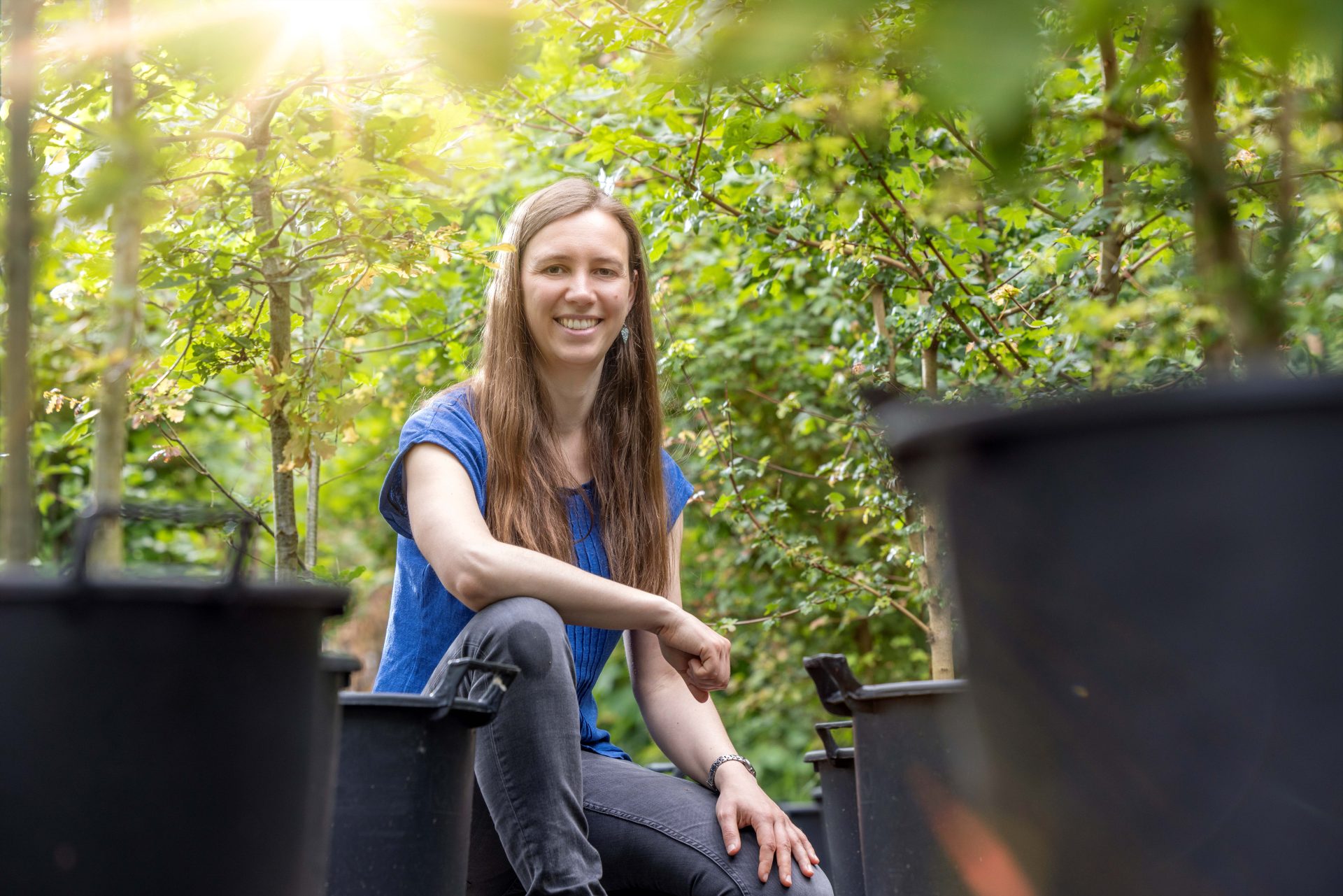
Eva Pfannerstill, Helmholtz Investigator Group Leader at Forschungszentrum Jülich and Junior Professor at the University of Cologne working in Atmospheric Chemistry and Air Quality, has received the 2026 EGU Atmospheric Sciences Division Outstanding Early Career Scientist Award. The award will be presented at the EGU General Assembly in Vienna in May 2026.
Eva and her Helmholtz Investigator Group, currently consisting of two PhD researchers, study climate–air quality feedbacks in biosphere–atmosphere exchange. More specifically, their research focuses on how climate-change–induced stress affects organic trace gases emitted by plants and how these emissions influence atmospheric chemistry. Their work relies on advanced mass spectrometry techniques. At the moment, the team is deeply engaged in analysing controlled chamber experiments from this summer, measuring emissions from stressed trees, and preparing for Zeppelin-based measurements over forests in North Rhine-Westphalia and the Netherlands next summer.
We asked the awardee why it matters to highlight achievements in this research field. Eva responded:
“Dedicated awards for Early Career Scientists are important because they consider academic age, celebrate the accomplishments of young researchers, and make them visible. For other EGU awards, your chances increase only much later in your career – almost as a ‘grey eminence’ – because the comparison pool is completely different.”
Eva also emphasised the strong importance of scientific communities such as the EGU:
“The EGU is a crucial platform for scientific exchange and new inspiration – through the annual meeting, which brings together more than 18,000 Earth system scientists, and through the journals it publishes, such as Atmospheric Chemistry and Physics. CESOC provides an additional platform for exchange and collaboration within the region and offers different opportunities for more direct, interdisciplinary cooperation compared to a Europe-wide organization like the EGU.”
Finally, we were curious to learn about Eva\’s advice she would give early career researchers aiming for a similar path. “Set yourself up for lucky coincidences,” Eva advises. She acknowledges that luck is always involved, but networking can help shape these opportunities. “The fact that I was supported by ICE-3 in my application for a Helmholtz Investigator Group was the result of a chain of fortunate circumstances, for example, that the institute director happened to be on sabbatical in Berkeley while I was a postdoc there.” She adds another recommendation:
“When applying for a junior research group, international experience is essential. So during your postdoc phase, do not stay where you earned your PhD – and use that time to learn new skills.”
We are proud to count award recipient Eva Pfannerstill as a CESOC member and look forward to supporting her continued journey. Well deserved!
Photo credits: FZJ